
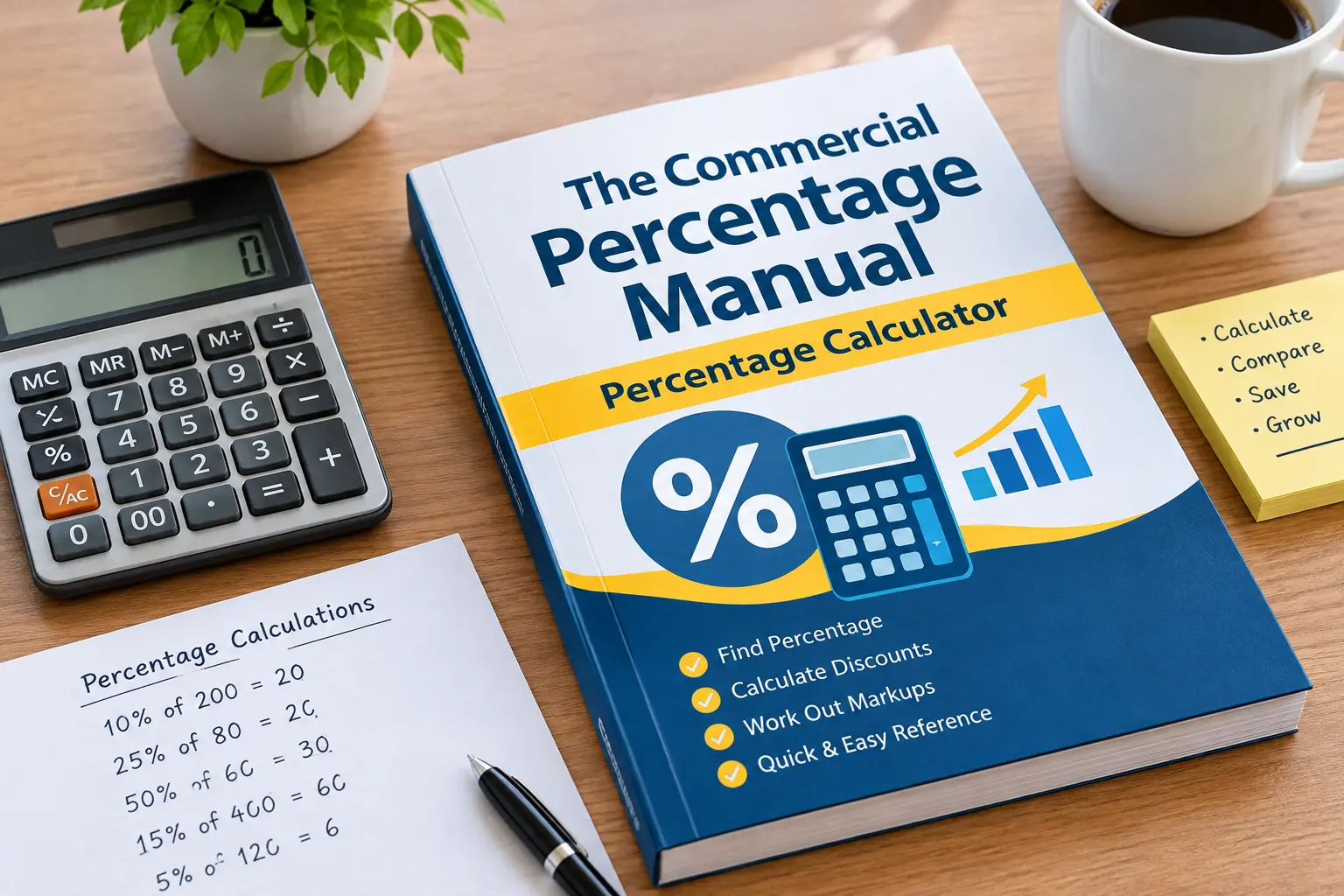
The Commercial Percentage Manual – Percentage Calculator
Relative parameters, operational margins and fractional tracking frameworks form the foundation of corporate bookkeeping tax compliance audits and conversion rate optimization. Whether you run a store and track markdown rates during seasonal sales work as a freelance professional managing business expenses or serve as an industrial purchasing agent calculating bulk trade discounts in high-pressure negotiations doing fractional arithmetic by hand can slow you down and cause errors.
The Commercial Percentage Manual. Percentage Calculator helps fix this. Many small business owners and digital professionals make management errors because they don’t grasp the difference, between a markup rate and a gross profit margin. This confusion leads to pricing, incorrect advertising returns and hidden revenue losses that eat into your profit.
Knowing how percentages affect your business measures helps you protect your earnings. Percentages affect your cash flow, your profit, your growth. Using a percentage calculator lets you track performance clearly. It gives you data, not guesses. When you switch from estimates to exact calculations you gain control. You can make decisions. You build a business that lasts.
What to Do – The Strategic Operational Plan for Enterprise Teams
Managing corporate metrics effectively requires protecting profit margins from calculation errors. Treat financial data as a structured framework that needs continuous tracking. I have seen that corporate metrics can be tricky. Before starting price adjustments processing seasonal promotional discounts with a Percentage Calculator or evaluating digital ad spend performance implement this comprehensive operational strategy.
First organize commercial data into separate clear data sets. I have found that grouping data sets helps. Keep fixed asset values isolated from operation costs so you can trace exactly where cash is going. Grouping numbers together without data boundaries makes it incredibly difficult to identify which products or services drive real revenue.
Second establish boundaries between pricing markup percentages and target net margins. I have seen that setting boundaries between pricing markup percentages and target margins is essential. A common financial trap is applying a twenty percent markup to a products base cost. Assuming a twenty percent profit margin on the final retail invoice. This error leaves business to hidden logistics expenses and inflation spikes.
Third run structural calculations across all active distribution channels. I have seen that running real‑time audits keeps you ahead. Do not wait for accounting audits to check performance metrics. Running continuous real‑time audits on conversions, retail markdowns and material costs gives you the insights needed to adapt quickly to changing market conditions.
Fourth keep commercial numbers completely safe from external tracking data scripts. I have found that keeping numbers safe from tracking scripts is a must. Percentage Calculator When auditing corporate statistics such as conversion limits, proprietary margins or financial growth targets avoid using messy third‑party web portals that log business inputs into centralized database servers.
Fifth use browser‑based tools to verify business math instantly during live vendor negotiations. I have seen that instant math checks make negotiations smoother. Having access, to exact fractional outputs allows team to close wholesale deals confidently eliminate billing discrepancies with suppliers and protect enterprise cash reserves from unnecessary leakage.
How It Works – The Core Architecture of Percentage Scaling
The percentage calculation engine works by removing raw numbers and turning mismatched values into clear easy-, to-analyze data sets. Percentage Calculator. At its core a percentage is a standardized fraction using one hundred as a base.
This structure helps business managers measure growth monitor performance and compare values that may seem unrelated on the same scale.
The engine processes your calculations by taking the percentage you choose dividing it by one hundred and forming a multiplier. That multiplier is then applied directly to your base value to give you the result.
Because everything happens inside your browser using local scripts your financial data never leaves your device. No data is sent over the internet. Everything stays private and fast.
The Underlying Mathematical Formula:
Percentage Value = (Percentage Rate / 100) x Base Scalar Value
When you type your numbers into the boxes the code automatically finds the percentage rate variable splits it by the base of one hundred and then takes the number it gets and multiplies it by the base scalar value. Percentage Calculator This local processing keeps your financial plans away, from data collecting networks and gives you very accurate calculations right away.
How to Use – Step by Step Instructions for the Interface Console
I find navigating our streamlined percentage tracking console takes only a few seconds and requires absolutely no technical or web design background.
Follow this step by step framework to get exact mathematical answers instantly:
Step 1: Find the first data entry box on the panel. This box is for your target percentage rate. Type the percentage coefficient into this box. Do not add percent signs, letters or special punctuation. For example if you need to calculate an eighteen percent sales tax just type the number 18.
Step 2: Move down to the input slot, which is for your total baseline scale value. Enter the sum from which you want to take the fractional percentage. This could be your gross project invoice amount, total advertising spend or raw inventory item count.
Step 3: Click the button labeled “Compute Value.” The script runs in your browser and instantly calculates an accurate answer showing every decimal place.
Step 4: Look at the calculation shown in the highlighted output window. If you want to try a business scenario or test other markup variations just replace the numbers, in the field slots and click the button again. The results update away.
Professional E-E-A-T. Trust Checklist
To maintain data standards and professional integrity across your operations every corporate manager should run their calculations against this validated compliance checklist:
- Data Integrity Verification: Make sure that your raw base integers are completely accurate and updated before running final business margin equations.
- Margin vs Markup Clarity: Always verify that your team is using the formula variations when distinguishing between cost markups and final retail profit margins.
- Privacy Shield Optimization: Confirm that your computational environment runs entirely client-side keeping data out of external database logs.
- Operational Continuity: Implement real-time fraction tracking, throughout your supply chain to catch and fix billing discrepancies early.
By following this disciplined manual business owners can protect their profit margins from human error optimize their accounting workflows and build an enduring highly profitable venture.
Video Downloader: mediafashions.com